Configuration
The Configuration page is the hub for the tenant's configuration: ingest, collectors, data lakes, entity tables, schemas, search facets, integrations, notifications, processors, report schedules, resource sync, AWS roles, application templates, and behavior rules. It holds no settings of its own; each card opens the page that manages one of these areas.
Menu path: Configuration · URL path: /v2/configuration
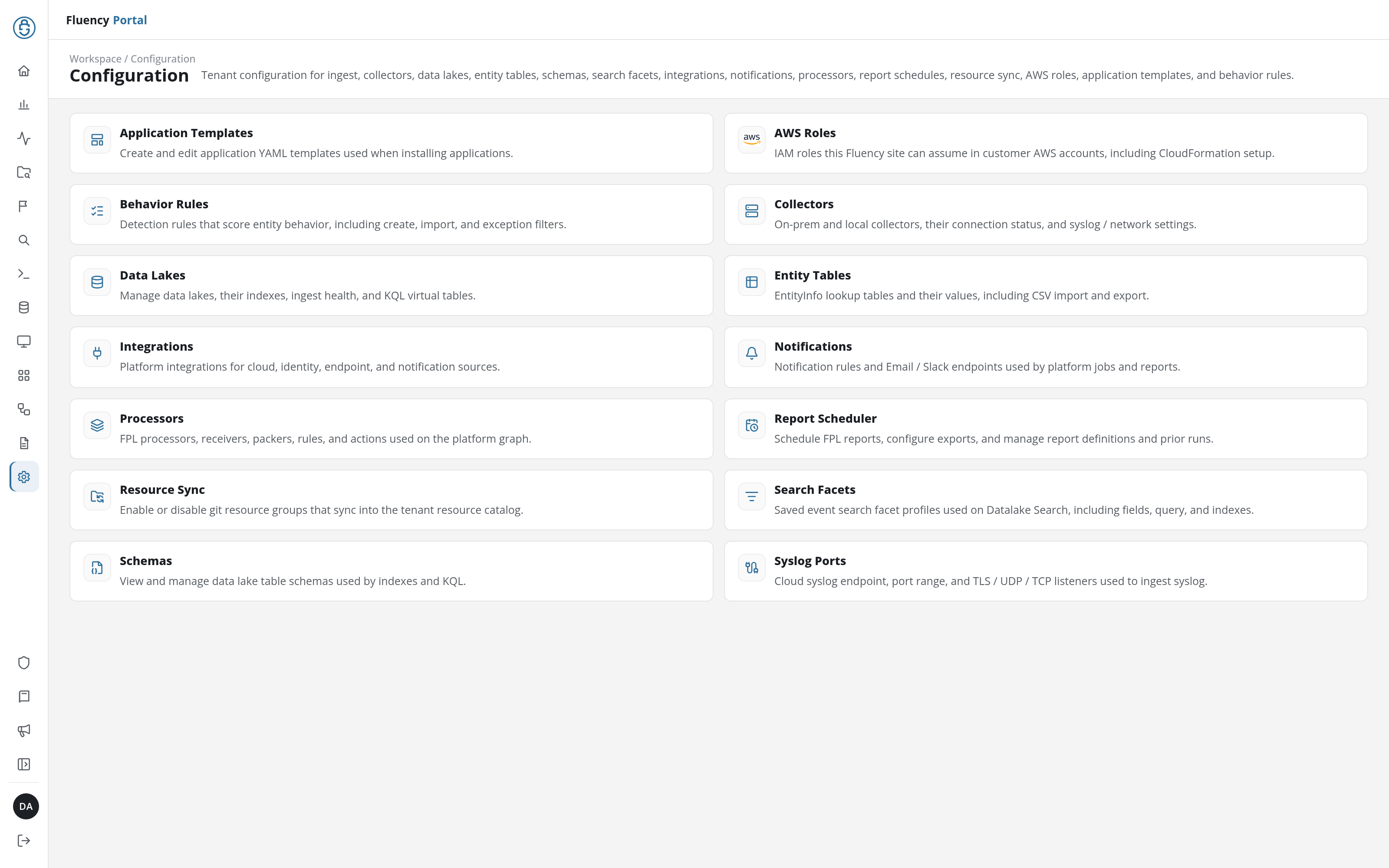
Page Layout
The breadcrumb reads Workspace / Configuration. The header shows the title Configuration with a one-line summary of what the tenant configuration covers. Below it, fourteen cards are laid out in two columns. Each card shows an icon, the page's name, and a description of what the page manages.
Click anywhere on a card to open its page. Every page opened from here has a Back to Configuration link above its title that returns to this hub.
An address under /v2/configuration/ that matches none of these pages (an old bookmark to a page the product no longer has, for example) shows Page not found and This configuration page is unavailable., with the same Back to Configuration link.
Configuration Pages
| Card | Card description |
|---|---|
| Application Templates | Create and edit application YAML templates used when installing applications. |
| AWS Roles | IAM roles this Fluency site can assume in customer AWS accounts, including CloudFormation setup. |
| Behavior Rules | Detection rules that score entity behavior, including create, import, and exception filters. |
| Collectors | On-prem and local collectors, their connection status, and syslog / network settings. |
| Data Lakes | Manage data lakes, their indexes, ingest health, and KQL virtual tables. |
| Entity Tables | EntityInfo lookup tables and their values, including CSV import and export. |
| Integrations | Platform integrations for cloud, identity, endpoint, and notification sources. |
| Notifications | Notification rules and Email / Slack endpoints used by platform jobs and reports. |
| Processors | FPL processors, receivers, packers, rules, and actions used on the platform graph. |
| Report Scheduler | Schedule FPL reports, configure exports, and manage report definitions and prior runs. |
| Resource Sync | Enable or disable git resource groups that sync into the tenant resource catalog. |
| Search Facets | Saved event search facet profiles used on Datalake Search, including fields, query, and indexes. |
| Schemas | View and manage data lake table schemas used by indexes and KQL. |
| Syslog Ports | Cloud syslog endpoint, port range, and TLS / UDP / TCP listeners used to ingest syslog. |