Fortinet FortiGate
FortiGate is Fortinet's next-generation firewall line, running FortiOS on hardware appliances and virtual machines from branch offices up to the data-centre perimeter. It produces three broad log types: traffic logs for sessions the firewall forwarded or blocked, UTM logs from the inspection engines (antivirus, web filter, application control, IPS, DNS filter, SSL inspection), and event logs covering system, VPN, user authentication and administrative activity. Its syslog output is emitted as key-value pairs, which makes it comparatively easy to parse reliably and a dependable backbone for network detection and investigation.
Device-side setup
Configure the device to forward syslog to the listener described below, following the vendor's own documentation for its syslog export. Nothing has to be built on the platform side beyond installing the template below — it supplies the parser and wires the pipeline.
Syslog configuration
The appliance sends to a syslog listener: either the cloud syslog endpoint or a local collector appliance. The two destinations use different ports. The cloud endpoint has a per-tenant domain and a block of ports allocated to your account: Platform → Administration → Syslog Ports shows the domain, the port range, and which protocol listens on which port — read the numbers off that page rather than assuming a standard one. A collector appliance listens by default on UDP/514, TCP/514, TLS on 6514 and TLS RFC 6587 on 7514, and each of its listeners can carry a Customer Tag that attributes the records arriving on it. See Syslog Import for the protocol options and Syslog Ports for the listener configuration. Either TLS listener presents a certificate the sending device has to trust: the Download CA (ca.crt) button on the Syslog Ports page supplies it, and without it the handshake fails with nothing logged on the platform side.
FortiOS frames its TLS syslog output with RFC 6587 octet counting, not the plain TLS framing. Send it to the TLS RFC 6587 listener — port 7514 on a default collector — not the plain Syslog TLS port. Pointed at a plain TLS listener the connection is accepted and the session looks healthy, but the records never parse. ::: Where a FortiAnalyzer already aggregates logs, forward from the analyzer rather than from each appliance.
Install the Application
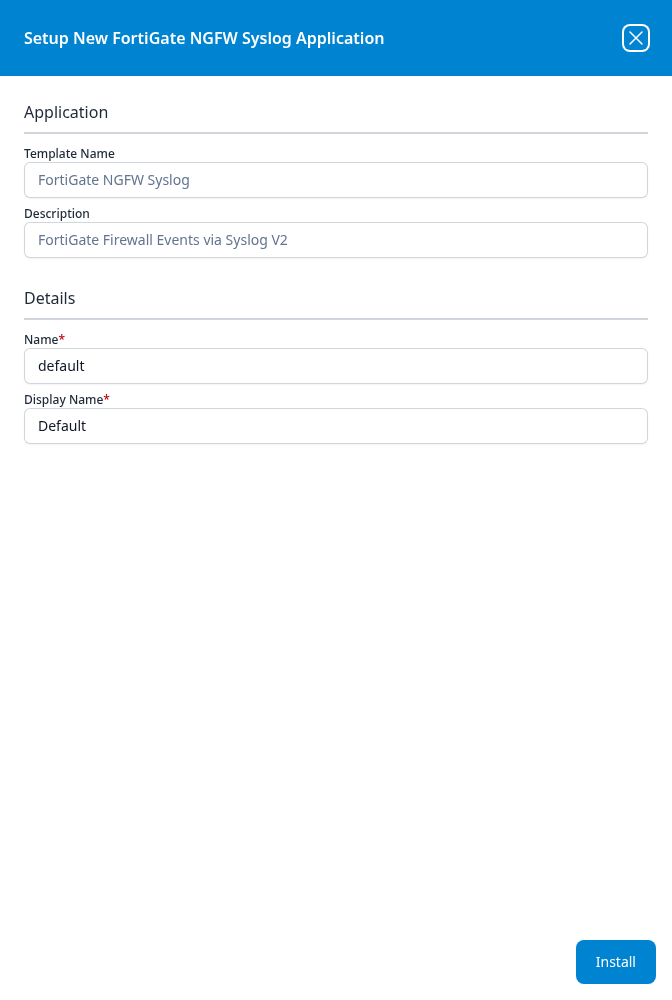
Go to Platform → Applications → Install Application From Template and choose FortiGate NGFW Syslog from the On-Premise IT category, then press Install. The tile no longer carries a V2 suffix, but the template behind it is unchanged: its description still reads FortiGate Firewall Events via Syslog V2 and its template ID is still FortiGateFWLogV2, so a configuration naming the V2 template and this tile are the same thing. The template takes no parameters: it supplies the parser and builds the pipeline, and the transport is configured on the syslog listener rather than on the form. There is no source to add, no processor to attach, and no sink to wire by hand.
Related
- On-Prem / Syslog — other syslog devices.
- Fortigate Firewall parser — the FPL parser cookbook for this device's syslog. The template ships a parser already, so this is only needed if you want to customise the parsing.
- Syslog Import and Syslog Ports — the transport and listener.
- Time Adjustment — a recipe for correcting device timestamps sent in local time.