Amazon CloudWatch
AWS CloudWatch LogGroup event export
There are three ways to export logs from a log group to an S3 bucket/SIEM/Data Lake or any other destinations. AWS Documentation
- Subscription filter with Kinesis Data Streams
- Subscription filter with Amazon Data Firehose
- Subscription filter with AWS Lambda
Fluency Platform supports all three methods.
Subscription filter with Amazon Data Firehose
Step 1: Setup IAM Roles for CloudWatch and Firehose service
- Create an S3 bucket to hold the log group data (shared by all log groups)
- Create a new IAM role and allow Firehose to write to the S3 bucket you created
- Create a new IAM role and allow CloudWatch to write to the Firehose stream
- CloudFormation Template
CloudFormation Parameters:
CloudWatchRole:fluencyCloudwatchToFireHoseFirehoseRole:fluencyFireHoseToS3S3Bucket:{yourcompany}-fluency-cloudwatch-firehose
Step 2: Add LogGroup one by one
- Create a new Firehose stream
- Create a new subscription filter for the log group and set the destination to the Firehose stream
- CloudFormation Template
CloudFormation Parameters:
CloudWatchRole:fluencyCloudwatchToFireHoseFilterName:passthroughFilterPattern:""FirehoseRole:fluencyFireHoseToS3LogGroup:S3Bucket:{yourcompany}-fluency-cloudwatch-firehoseName://S3 object Prefix
Step 3: Configure an "S3 bucket" integration in Fluency
-
Set the bucket and region
-
Set the mode to read
-
Select the AWS authentication method:
- EC2 Instance Role
- IAM User
- Access Key (create a new IAM user)
Step 4: Add an "S3" type data source in Fluency
- Set the Receiver to
CloudwatchEventSplit - Set input to
JSON
function main({obj, size, source, props}) {
    if (obj.messageType != "DATA_MESSAGE") {
      return null
    }
    let list = []
    let logEvents = obj.logEvents
    if (!logEvents) {
       printf("logEvents field not found")
       return null
    }
    for i, event = range logEvents {
      let envelop = {
         logGroup: obj.logGroup,
         logStream: obj.logStream,
         subscriptionFilters: obj.subscriptionFilters,
         "@message": event.message,
         "@type": "event",
         "@timestamp": event.timestamp,
         "@source": obj.logStream
      }
      list = append(list, envelop)
    }
    return list
}
Pros
- Easy to setup
- Cheaper than Kinesis Data Streams
Cons
- One Firehose for one destination
- Limited destination options
Subscription filter with Kinesis Data Streams
Step 1: Setup IAM Roles for CloudWatch and Kinesis service
- Create a new Kinesis stream
- Create a new IAM role and allow CloudWatch to write to the Kinesis stream
- Create a new subscription filter for the log group and set the destination to the Kinesis stream
- CloudFormation Template
CloudFormation Parameters:
CloudWatchRole:fluencyCloudwatchToKinesisFilterName:passToKinesisStreamNameLogGroup
Step 2: Configure an "AWS Kinesis" integration in Fluency
-
Set the Kinesis stream name and region
-
Set the mode to read
-
Select the AWS authentication method:
- EC2 Instance Role
- IAM User
- Access Key (create a new IAM user)
Step 3: Add a "Kinesis" type data source in Fluency
- Set the Receiver to
CloudwatchEventSplit - Set input to
JSON
Pros
- Easy to setup
- Flexible destination options
- 24 hours data retention
Cons
- More expensive (each stream costs $0.10 per hour plus data ingress cost)
Subscription filter with Lambda
-
Create an S3 bucket for the Lambda function to write to
-
Create an IAM role for the Lambda function (execution role)
- Allow Lambda to write to the S3 bucket
- Allow Lambda to write to CloudWatch Logs (if logging is needed)
-
Create a Lambda function:
import datetime
import os
import uuid
import base64
import boto3
import time

def lambda_handler(event, context):

    LOGGROUP = os.environ['LOGGROUP']
    DESTINATION_BUCKET = os.environ['BUCKET']
    PREFIX = os.environ['PREFIX']
    currentTime = datetime.datetime.now()
    LOGGROUP = LOGGROUP.replace('/','_')
    OBJECT_PREFIX = os.path.join(PREFIX, LOGGROUP, currentTime.strftime('%Y%m%d').format(os.path.sep))
    encoded_zipped_data = event['awslogs']['data']
    zipped_data = base64.b64decode(encoded_zipped_data)

    basename = currentTime.strftime('%H-%M-%S')
    object_path = '{}/{}-{}.json.gz'.format(OBJECT_PREFIX, currentTime.strftime('%H-%M-%S'),uuid.uuid1())
    s3 = boto3.client('s3')
    s3.put_object(Body=zipped_data, Bucket=DESTINATION_BUCKET, Key=object_path)
-
Attach a resource permission policy to this Lambda to allow the CloudWatch LogGroup to invoke it
-
Create a new subscription filter for the log group and set the destination to the Lambda function
CloudFormation Parameters:
S3BucketS3ObjectPrefixLambdaRoleLambdaFunctionNameLogGroupFilterPatternFilterName
Step 2: Configure an "S3 bucket" integration in Fluency
-
Set the bucket and region
-
Set the mode to read
-
Select the AWS authentication method:
- EC2 Instance Role
- IAM User
- Access Key (create a new IAM user)
Step 3: Add an "S3" type data source in Fluency
- Set the Receiver to
CloudwatchEventSplit - Set input to
JSON
Pros
- Flexible destination options
- Cheapest solution (only pay Lambda invocation cost)
Cons
- More complex setup
Install the Application
Go to Platform → Applications → Install Application From Template and choose CloudWatch LogGroup from the AWS Services category.
| Parameter | Notes |
|---|---|
| AWS Region | Drop-down, opens on US N.Virginia. |
| SQS notification queue url | The full queue URL, not the ARN. |
| Pre-defined AWs Role | Optional. A role registered on Platform → Integrations. |
| IAM access key | Optional. Use instead of a role, not as well as. |
| IAM access secret | Optional. |
| datalake | Pre-filled managed. |
| datalake index name | Pre-filled default — change it. Two applications writing to the same index name in the same lake will collide, and the second one aborts. |
Unlike AWS CloudTrail, this template has no Pre-defined AWs User field.
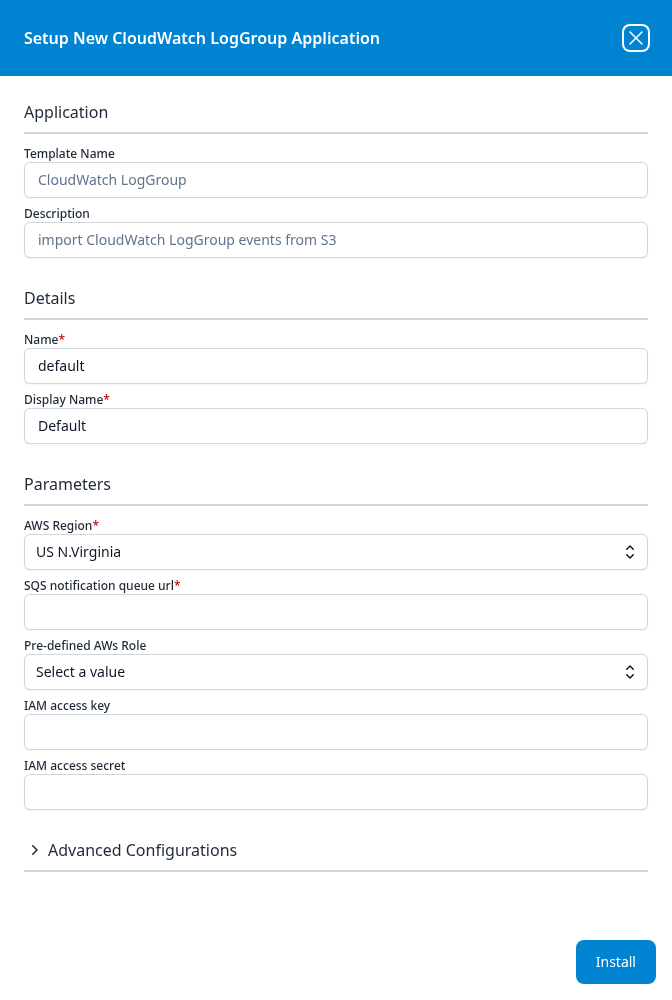
Press Install. The application then appears in the Installed Applications view, where its badge reads Running once the pipeline is up.
Read-only API access (pull method)
The three methods above are push subscriptions. CloudWatch Logs can also be read directly through the AWS API using an IAM user granted read-only access, which is the approach the retired manual-setup guide described.
For this method the only AWS-side requirement is to attach these two AWS-managed policies to the IAM user assigned to the platform:
CloudWatchReadOnlyAccess
CloudWatchLogsReadOnlyAccess
Attach them from IAM → Users → (the user) → Permissions → Add permissions → Attach existing policies directly, then select which log groups to collect on the platform side.
The Install the Application section above is verified against the current interface. The platform-side steps for selecting log groups below were written for an interface that no longer exists — use them as background only, and see the AWS overview for the current account access methods.