FAQ
This FAQ was last updated in 2023. Its answers predate the current web interface and the current product positioning, and several of the pages it links to have moved. Treat it as historical context and verify any answer against the rest of this manual before acting on it.
Frequently Asked Questions:
Does Fluency require (physical/virtual) collectors?
No, The Fluency server is also a collector itself. For larger user with on-prem or private cloud VPCs, Fluency supports physical or virtual collectors. But sending data directly to Fluency (upload-to-cloud, or cloud-to-cloud) is fully supported for most users.
Does Fluency support encrypted data for uploading?
Yes. Both destinations accept TLS. On the cloud syslog endpoint the port is allocated to your tenant — Platform → Administration → Syslog Ports shows the domain and which port carries Syslog TLS and which carries TLS RFC 6587, and the same page's Download CA (ca.crt) button supplies the certificate the sender has to trust. On a collector appliance the defaults are 6514 for tls and 7514 for tls (RFC6587). A collector has the further advantage of uploading to the cloud instance over HTTPS, so devices that can only speak plaintext syslog never cross the internet in the clear.
What types of data (format) does Fluency ingress?
JSON formatted data is preferred but Fluency has the ability to parser many types of data. In fact, Fluency already supports parsers for many commonly seen devices out-of-box. In cases were your data format is not supported, Fluency Support will work to create a parser.
See the Integration Matrix for a full list of supported devices.
Does Fluency provide integration with other vendor's APIs?
Yes. Fluency supports a variety of cloud APIs through its application templates — 65 of them at the last catalog capture, covering AWS, Microsoft 365, Okta, CrowdStrike, SentinelOne and many more. Each is installed by filling in a short form rather than by building a pipeline.
The catalog lives on Platform → Applications under Install Application From Template, with a search box across the top and one card per category:
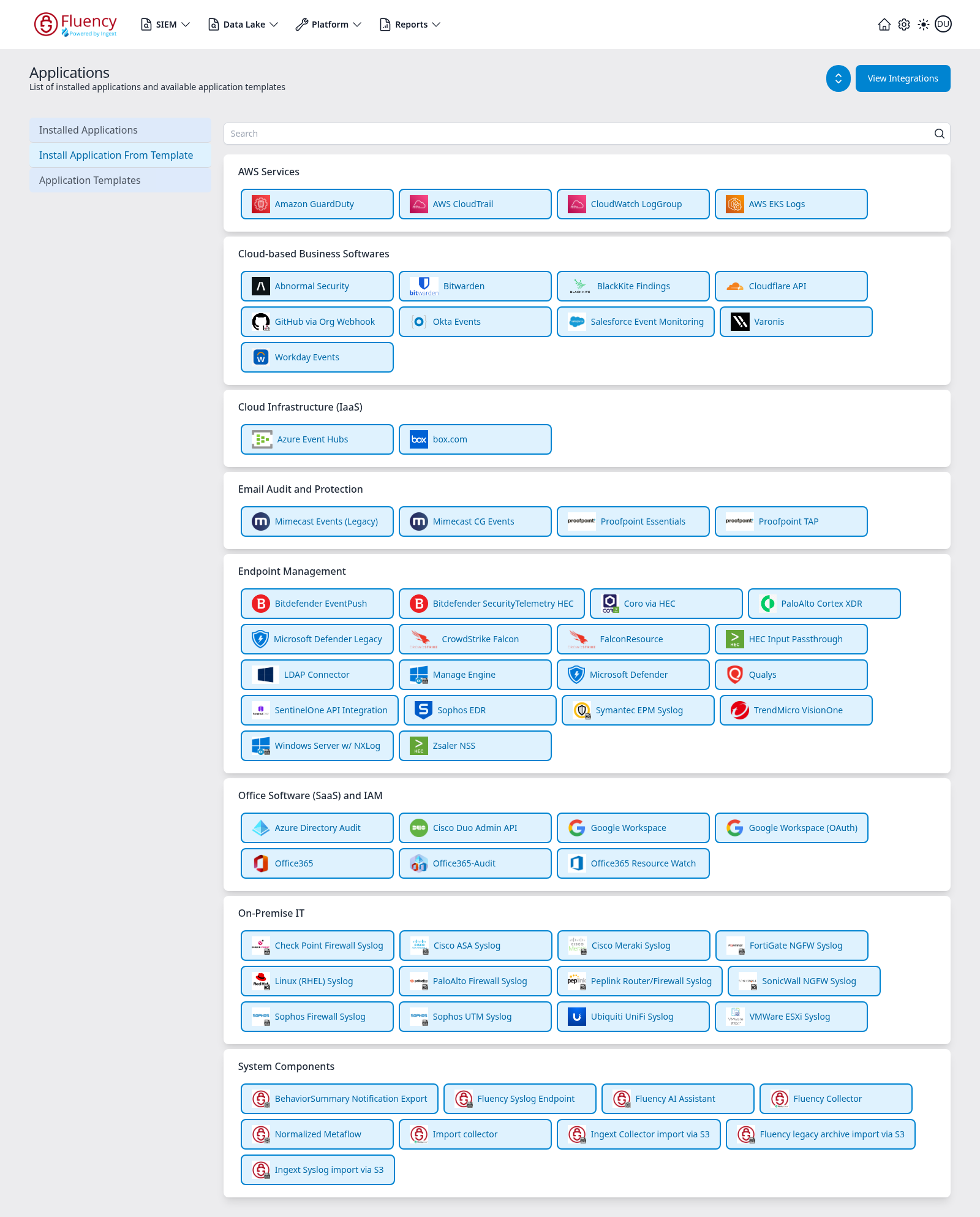
| Category | Templates |
|---|---|
| AWS Services | 4 |
| Cloud-based Business Softwares | 9 |
| Cloud Infrastructure (IaaS) | 2 |
| Email Audit and Protection | 4 |
| Endpoint Management | 18 |
| Office Software (SaaS) and IAM | 7 |
| On-Premise IT | 12 |
| System Components | 9 |
Clicking a tile opens a Setup New <template> Application panel with three sections — Application (the read-only Template Name and Description), Details (Name and Display Name, pre-filled with default and Default), and Parameters (the template's own fields) — and an Install button in the lower-right corner.
See Integrations for what each template connects to, and Install Application From Template for the exact parameter list of all 65.
Does Fluency support streaming data feeds from Endpoint Detection and Response tools?
Yes. Fluency’s design is structured such that you do support streaming data feeds such as SentinelOne’s Deep Visibility Hermes feeds directly from their tool. This is in parallel to their syslogs and APIs.
Do you have prebuild query/reports/behavioral rules?
Yes. Fluency comes pre-packaged with access to the default content repository. Clients simply enable the desired "category" in the Resource Sync page. Fluency will then download the pre-built items, and automatically track updates with the GitHub repository.
How to reach Fluency Support?
Raise a support ticket on the Fluency service desk — that is the route that gets a tracked case. Email also reaches support, and Slack or Microsoft Teams are alternatives: ask support to add you to the shared channel if you would prefer that route.
Does Fluency have API documentation?
Yes. The current API documentation can be found at the following site:
https://api.fluencysecurity.com/